
Why “Keeping the Business for the Kids”May Not Be the Most Prudent Decision
As a Partner with The NewBridge Group, a brokerage and advisory firm focused exclusively on the funeral profession, I have the privilege of speaking with funeral home owners every day. One comment I hear frequently is:
“The business is generating good cash flow, so I’ll just keep it and pass it down to my children.”
For many families, that has been a successful strategy for generations. Passing a family business to the next generation is an admirable goal and one that has helped shape our profession. However, today’s funeral service landscape is changing rapidly, and it may be worth asking whether keeping the business is still the best long-term financial decision—for both you and your
family.
Several trends are reshaping the industry:
- Funeral service revenue is projected to decline at a compound annual growth rate of 3.3% over the next five years. IBISWorld
- The death rate is proving to level off following the temporary increases experienced during the pandemic years.
- Cremation continues to gain market share and now represents approximately 63.4% of dispositions nationwide climbing toward 82.3% by 2045, placing continued pressure on traditional funeral revenue. *NFDA
While these trends do not mean every funeral home will lose value, they do suggest that owners should periodically evaluate whether holding the business continues to be their best investment.
Perhaps the most overlooked consideration is this: selling a funeral home can, in many cases, generate greater long-term financial security for both the owner and the next generation than continuing to own and operate the business.
Many owners have the vast majority of their personal net worth invested in a single asset—their funeral home. A sale allows them to diversify that wealth, reduce risk, and potentially create an income stream that equals or even exceeds the annual cash flow generated by the business itself. I often encourage owners to sit down with their financial advisor and ask a simple question:
“How much would I need to net from the sale of my business, after taxes and debt, to replace or exceed my current annual income?”
The answer frequently surprises them.
One major factor often overlooked is the power of compound interest. While many prudent owners are investing a percentage of their annual cash flows into a diversified market portfolio, many are not able to invest significantly. A sale transaction will create significant liquidity, allowing an owner to invest a sizable amount sooner, rather than later. This investment will grown much more rapidly and can, in theory, provide a family with much more net worth than keeping the business in the family. Over the last 50 years, the S&P 500 has delivered a nominal annualized return of 11.85% when dividends are reinvested. Over the last 5 years, the S&P 500 has generated an average annualized total return of 14.5% when factoring reinvested dividends. This translates to a total compounded return of 95.6% over the five-year stretch.
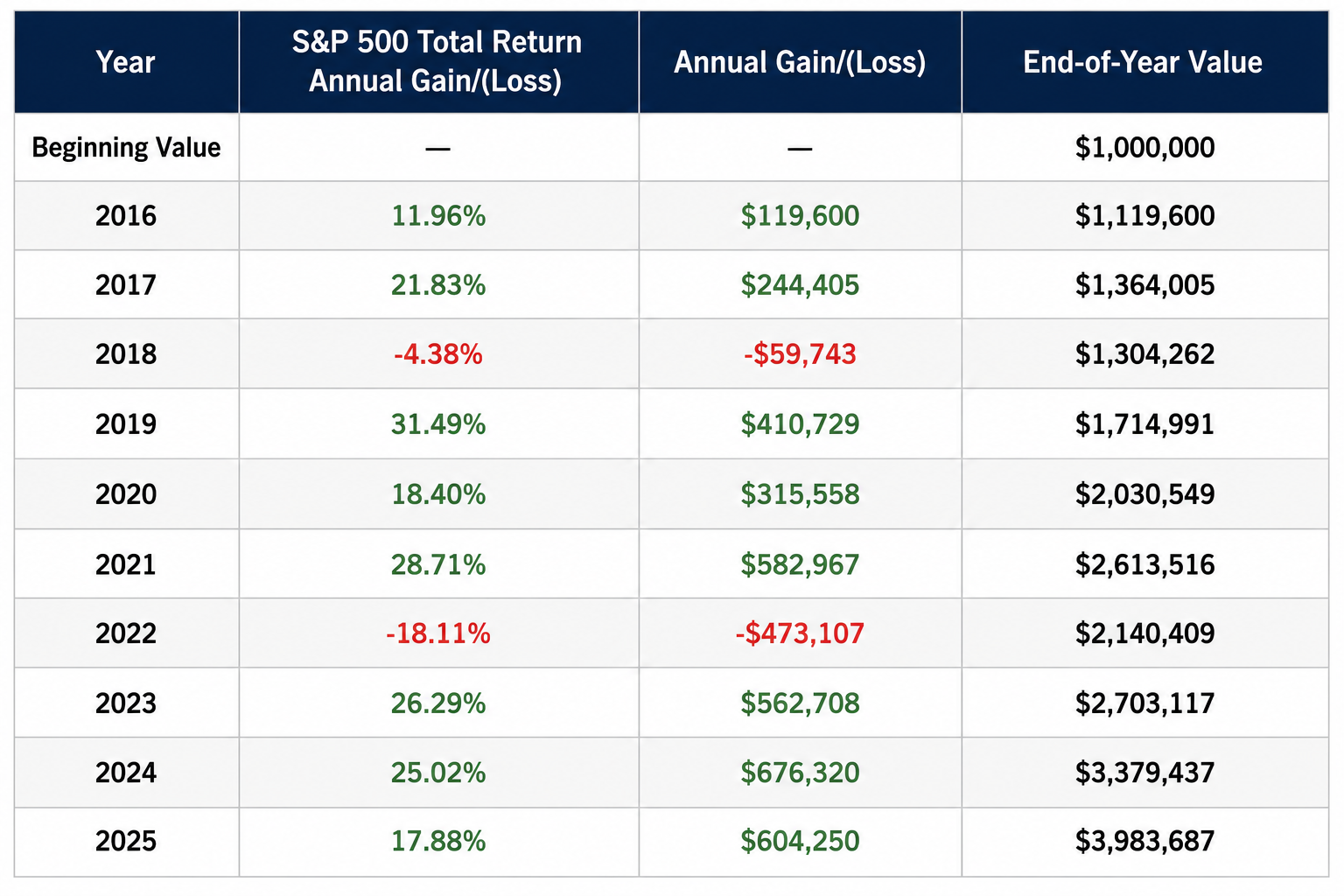
Using the S&P 500 Total Return Index (which assumes all dividends are reinvested), a $1,000,000 investment at the beginning of 2016 would have grown as follows:
Summary
- Initial Investment (1/1/2016): $1,000,000
- Ending Value (12/31/2025): $3,983,687
- Total Gain: $2,983,687
- Total Return: 298.4%
- Compound Annual Growth Rate (CAGR): ≈14.8% per year
This is a powerful illustration of compounding. Despite experiencing two negative years (2018 and 2022), the investment nearly quadrupled over the 10-year period because gains remained invested and continued to compound.
A funeral home owner who nets $1 million from the sale of a business and invests it prudently in a diversified portfolio may find that the investment generates competitive long-term returns while eliminating much of the operational and industry risk associated with owning a single business. Over the past decade, $1 million invested in the S&P 500 Total Return Index grew to nearly $4 million, assuming dividends were reinvested.
However, please note that past performance is not indicative of future results and owners should consult their financial advisor regarding investments and tax implications.
Another common misconception is that selling means giving up the community legacy you’ve spent decades building. In reality, many buyers prefer to retain the funeral home’s name, preserve its reputation, and keep the existing staff in place. Your legacy may continue for many years while your family’s financial future becomes more secure.
Every family’s circumstances are different. For some, passing the business to the next generation remains the right decision. For others, selling while market conditions are favorable may provide greater financial flexibility, reduce future operating risk, and ultimately leave more wealth for their children.
The key is to evaluate all of your options before making one of the most important financial decisions of your life.
If you would like a confidential conversation about today’s market, recent transaction activity, or the likely value of your funeral home, I would be happy to help. There is never an obligation—just an opportunity to better understand your options.
Todd K. Reich
Co-Managing Partner
The NewBridge Group
404-542-9956
todd@newbridgegroup.com