
When Waiting to Sell Becomes Costly
In the succession planning process, many funeral home owners I speak with often tell me, “I’m going to hold off a couple of years to explore a sale”. They frequently say that they are not ready to retire and believe that the value of their funeral home will be higher in the future.
Another, more subtle reason for “not being ready” is the fact that change is hard. Many funeral home owners spend a large part of their lives in the funeral home, and preparing for a sale requires a shift in mindset and daily habits. When debating whether now is the right time to make the change, funeral home owners often justify waiting by saying the business will be worth more in a few years. However, unlike a house or land, a funeral home’s value is primarily set by the income that it can produce for its owner. As the industry faces major headwinds and challenges, this income may actually trend down over time, bringing valuations down accordingly.
Unfortunately, owner retirement plans often don’t align with the maximum business value in a timely manner. In today’s economy, there are many factors affecting future business value. Listed below are some considerations of waiting to sell:
Are your Revenue and Profit Margins increasing each year?
If you believe your revenue trends will continue on an upward trajectory, it can be prudent to wait to sell. However, just because revenues are increasing doesn’t necessarily mean the business value is increasing. Many costs are rising. So, if revenues are not outpacing your expenses, your profit margins could be flat or even shrinking. The main driver of business value is the cash flow available to the owner (sometimes referred to as EBITDA: Earnings Before Interest, Taxes & Depreciation)
To see an increase in the value for your funeral business over time, this bottom-line number will need to grow steadily each year. Having a year-over-year stable cash flow will give a buyer a lot of confidence in their ability to operate your business as you have been and therefore pay a premium. However, there may still be factors both inside and outside of your business’s control that could influence a valuation over time. A few of these are outlined below:
Do you have relatively younger, energetic, full-time staff?
As we all know, finding and retaining good-quality staff is a rarity in funeral service. The younger generations are now more attuned to other opportunities through social media and college degrees. It’s still an honor to take over the family business in most communities; however, the fact is that salaries are not commensurate with those in other industries. Buyers look closely at your staff longevity, so if you are looking out 5-10 years and predict fewer and lower-quality staff, now may be the time to address this or consider a sale.
How is your competition performing?
Are you gaining or losing market share? Most savvy owners are not only aware of their local death rate trends, but also of how they stack up vs. the competition. Low-cost crematory client families often don’t post obituaries, so it can sometimes be a challenge to see where you stand. However, more often, owners have a pretty good idea of the direction they are going.
What are interest rates doing?
As you probably know, interest rates (i.e., the cost of capital) have risen —almost doubled over the last several years. Below is a snapshot of the Federal Funds rate over the last five years.
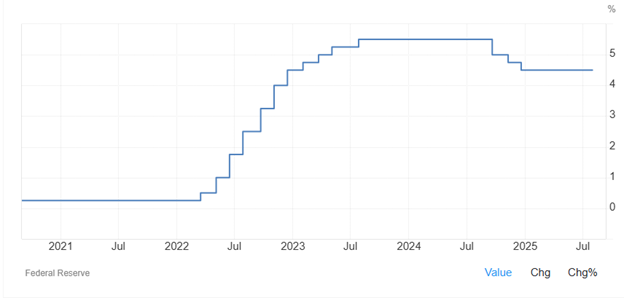
Interest rate projections vary over the next 10 years; however, most economists predict a gradual decline through 2027. Timing a sale based on interest rate projections has been a losing bet for many prospective sellers over the last five years. This should not be a primary decision-making factor, in my opinion.
What are the inflation trends doing?
As you likely have experienced, the cost of goods, including caskets, supplies, vaults, etc., has also risen over the last decade. Below is a chart of the last 20 year annual inflation rates as measured by the US Consumer Price Index.
As you can see, starting in 2022, prices of goods took off significantly. With the looming tariff uncertainty, the next five years look daunting.

What are the pool of buyers doing?
NewBridge keeps an active, ever-changing list of prospective buyers. Apart from the public funeral home companies, several private equity-backed businesses dipped their toe in the acquisitions water over the last decade. Unfortunately, many of these took on debt and purchased aggressively based on pro forma projections that did not play out as expected. Many of these, we believe, were based on COVID trends and did not fully consider the “pull forward” effect. In addition, projections were based on historically lower interest rates. As a result, many of these firms have stopped buying altogether and are focused on right-sizing operations.
What about a younger individual buyer?
It’s surprising how many owners believe they will attract a young professional, either coming out of mortuary school or currently working for them or a competitor in the community, to ultimately make an offer on their business. In our experience, the younger generation has a different mindset and is generally averse to long-term debt. They value the security of a job where they can show compassion and achieve a sense of purpose and fulfillment. However, the fact is that there just are not enough younger directors available, even if there is an attractive funeral home in an attractive community. According to IBIS World and the US Department of Commerce, there were 15,703 funeral homes in operation in 2022. According to the American Board of Funeral Service Education, there were only 2,016 graduates from mortuary schools in 2024. Of course, most individual buyers would have much more experience, but this gives you a sense of the ratio of new directors to funeral homes: one new licensed candidate per 7-8 funeral homes. This is, of course, assuming all graduates remain in funeral service. As such, considering a sale to a larger funeral home sooner vs. later may be the prudent choice.
What is the age of the owner and size of staff?
According to a recent NFDA report, the average U.S. funeral home generates $1.1 million in annual revenue. Typically, these funeral homes have 1-3 full-time funeral directors. As a buyer, if you are looking at these, you are very cautious about the age and health of not only the owner, but also the full-time staff. Most buyers today are not bringing any staff to the transaction and prefer (and need) the current owner and all staff to stay on board through a negotiated transition period.
Another consideration of waiting to sell is the impact on your family legacy.
Historically, owning a funeral home has been an honor, and directors are looked up to and respected in their communities. This is still true today for many funeral homes. Unfortunately, due to several factors, including difficulty finding good quality staff who can work nights & weekends, real estate values that don’t align, and shifting consumer preferences, a sale may be the right thing to consider for your family and legacy. Particularly, if the majority of your family net worth is tied up in the business, it may be best to “take some chips off the table” with a sale, and invest those proceeds into a diversified market portfolio. A sale does not have to mean retirement, and most buyers prefer you to stay on board at least a few months through a transition. This decision may be the best way to protect and preserve your family legacy vs. watching the business decline in value.
If you are ready for a confidential, frank conversation, please reach out any time. We are working with proactive, well-funded buyers who are generally seeking:
- Revenues/location: Over $800,000 USD
- Anywhere in the U.S.
- More than one full-time Director (unless close to an existing buyer location)
- Strong business reputation based on a history of service-first mindset and community involvement
Todd K. Reich
404-542-9956